When a Firm Produces Less Output, It Can Reduce:
The Shutdown Bespeak
The possibility that a firm may earn losses raises a question: Why can the firm not avoid losses by shutting downwardly and not producing at all? The respond is that shutting down can reduce variable costs to zero, but in the short run, the firm has already paid for fixed costs. Every bit a outcome, if the firm produces a quantity of zero, information technology would withal make losses because it would still need to pay for its fixed costs. Then, when a house is experiencing losses, it must face a question: should information technology go on producing or should information technology shut down?
As an case, consider the situation of the Yoga Center, which has signed a contract to rent space that costs $10,000 per month. If the firm decides to operate, its marginal costs for hiring yoga teachers is $15,000 for the month. If the firm shuts down, it must nevertheless pay the rent, but it would non need to hire labor. Let'southward take a wait at three possible scenarios. In the first scenario, the Yoga Center does not have any clients, and therefore does not brand any revenues, in which case it faces losses of $10,000 equal to the fixed costs. In the second scenario, the Yoga Center has clients that earn the center revenues of $x,000 for the month, but ultimately experiences losses of $15,000 due to having to hire yoga instructors to embrace the classes. In the third scenario, the Yoga Center earns revenues of $20,000 for the calendar month, just experiences losses of $5,000.
In all iii cases, the Yoga Center loses money. In all 3 cases, when the rental contract expires in the long run, assuming revenues exercise not meliorate, the firm should exit this business. In the short run, though, the decision varies depending on the level of losses and whether the business firm can cover its variable costs. In scenario i, the center does not take any revenues, and so hiring yoga teachers would increase variable costs and losses, so it should close down and but incur its stock-still costs. In scenario ii, the center'due south losses are greater because it does not make plenty revenue to offset the increased variable costs plus fixed costs, and then information technology should shut down immediately. If price is below the minimum average variable cost, the firm must shut down. In dissimilarity, in scenario 3 the acquirement that the center tin earn is high plenty that the losses diminish when it remains open, so the center should remain open in the curt run.
Should the Yoga Center Shut Down At present or Later?
Scenario 1
If the heart shuts downwards at present, revenues are goose egg merely it volition not incur whatsoever variable costs and would simply demand to pay fixed costs of $10,000.
profit = total revenue – (fixed costs + variable toll)
profit = 0 – $10,000 = –$x,000
Scenario ii
The center earns revenues of $x,000, and variable costs are $15,000. The center should shut downward now.
profit = total acquirement – (stock-still costs + variable cost)
profit = $x,000 – ($ten,000 + $fifteen,000) = –$15,000
Scenario 3
The center earns revenues of $20,000, and variable costs are $xv,000. The center should continue in business.
profit = total revenue – (fixed costs + variable cost)
turn a profit = $20,000 – ($ten,000 + $xv,000) = –$five,000
This case suggests that the primal factor is whether a firm can earn enough revenues to cover at least its variable costs by remaining open. Allow'south render now to our raspberry farm. Figure viii.vi illustrates this lesson by adding the average variable toll curve to the marginal price and average cost curves. At a price of $2.20 per pack, as shown in Figure 8.6 (a), the farm produces at a level of fifty. It is making losses of $56 (every bit explained before), but toll is above average variable cost and then the firm continues to operate. However, if the price declined to $ane.80 per pack, as shown in Figure 8.6 (b), and if the firm applied its rule of producing where P = MR = MC, it would produce a quantity of 40. This price is below average variable cost for this level of output. If the farmer cannot pay workers (the variable costs), then it has to shut down. At this price and output, total revenues would be $72 (quantity of 40 times price of $one.lxxx) and total cost would exist $144, for overall losses of $72. If the farm shuts down, information technology must pay just its stock-still costs of $62, and so shutting down is preferable to selling at a cost of $i.80 per pack.
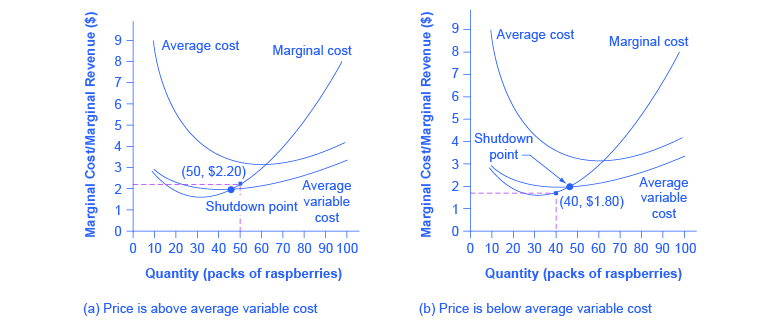
Figure 8.6. The Shutdown Point for the Raspberry Subcontract. In (a), the farm produces at a level of 50. It is making losses of $56, just price is above boilerplate variable cost, and then information technology continues to operate. In (b), full revenues are $72 and full cost is $144, for overall losses of $72. If the farm shuts down, it must pay just its stock-still costs of $62. Shutting downwardly is preferable to selling at a price of $1.eighty per pack.
Looking at Tabular array 8.half dozen, if the price falls below $2.05, the minimum boilerplate variable cost, the firm must shut downwardly.
Table 8.6. Cost of Production for the Raspberry Farm
| Quantity | Total Cost | Stock-still Toll | Variable Cost | Marginal Toll | Average Cost | Boilerplate Variable Cost |
|---|---|---|---|---|---|---|
| 0 | $62 | $62 | – | – | – | – |
| 10 | $90 | $62 | $28 | $2.fourscore | $ix.00 | $2.eighty |
| 20 | $110 | $62 | $48 | $2.00 | $five.50 | $2.40 |
| 30 | $126 | $62 | $64 | $one.sixty | $4.twenty | $two.xiii |
| twoscore | $144 | $62 | $82 | $1.80 | $3.lx | $two.05 |
| 50 | $166 | $62 | $104 | $2.xx | $3.32 | $2.08 |
| 60 | $192 | $62 | $130 | $ii.60 | $three.twenty | $2.16 |
| 70 | $224 | $62 | $162 | $iii.20 | $3.20 | $two.31 |
| fourscore | $264 | $62 | $202 | $4.00 | $iii.30 | $2.52 |
| xc | $324 | $62 | $262 | $vi.00 | $3.60 | $ii.91 |
| 100 | $404 | $62 | $342 | $8.00 | $4.04 | $three.42 |
The intersection of the average variable cost curve and the marginal cost curve, which shows the toll where the business firm would lack enough revenue to cover its variable costs, is called the shutdown point . If the perfectly competitive firm tin can accuse a cost above the shutdown bespeak, then the firm is at to the lowest degree roofing its average variable costs. It is also making enough revenue to cover at least a portion of stock-still costs, so it should limp alee even if information technology is making losses in the short run, since at least those losses volition be smaller than if the firm shuts down immediately and incurs a loss equal to total fixed costs. However, if the house is receiving a cost below the price at the shutdown point, and so the firm is non fifty-fifty covering its variable costs. In this case, staying open is making the firm's losses larger, and information technology should shut downwards immediately. To summarize, if:
- price < minimum average variable toll, then firm shuts down
- cost = minimum average variable cost, so firm stays in business
Short-RUN OUTCOMES FOR PERFECTLY COMPETITIVE FIRMS
The boilerplate cost and average variable price curves divide the marginal toll curve into iii segments, equally shown in Figure 8.seven. At the marketplace price, which the perfectly competitive firm accepts equally given, the profit-maximizing firm chooses the output level where price or marginal revenue, which are the same thing for a perfectly competitive house, is equal to marginal cost: P = MR = MC.
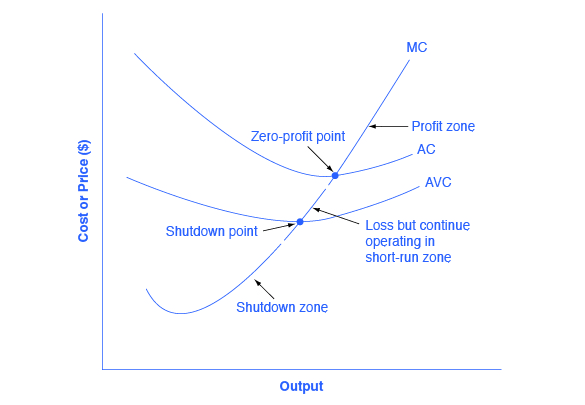
Figure 8.7. Profit, Loss, Shutdown. The marginal toll bend tin exist divided into three zones, based on where it is crossed by the boilerplate cost and average variable cost curves. The point where MC crosses Ac is called the zero-profit point. If the firm is operating at a level of output where the market price is at a level higher than the zero-turn a profit signal, then cost volition exist greater than average cost and the firm is earning profits. If the price is exactly at the naught-profit bespeak, then the firm is making zero profits. If price falls in the zone betwixt the shutdown betoken and the nil-profit point, then the firm is making losses but will continue to operate in the brusk run, since it is roofing its variable costs. However, if price falls below the price at the shutdown point, then the firm will close down immediately, since it is non even covering its variable costs.
Outset consider the upper zone, where prices are in a higher place the level where marginal cost (MC) crosses average toll (Ac) at the nothing turn a profit signal. At any cost higher up that level, the firm will earn profits in the short run. If the price falls exactly on the zero turn a profit point where the MC and Air conditioning curves cross, and so the firm earns zero profits. If a price falls into the zone between the zero profit point, where MC crosses Air conditioning, and the shutdown point, where MC crosses AVC, the firm volition be making losses in the short run—only since the firm is more than covering its variable costs, the losses are smaller than if the firm shut down immediately. Finally, consider a price at or beneath the shutdown point where MC crosses AVC. At any toll like this 1, the firm will shut downwards immediately, because it cannot even encompass its variable costs.
Lookout man this video to encounter an illustrated example of zip profit, or the normal profit, betoken:
MARGINAL COST AND THE FIRM'S SUPPLY Bend
For a perfectly competitive business firm, the marginal cost curve is identical to the firm'due south supply bend starting from the minimum point on the average variable cost bend. To empathize why this mayhap surprising insight holds truthful, first remember about what the supply curve means. A firm checks the market place price and so looks at its supply curve to decide what quantity to produce. Now, call back nigh what it means to say that a firm will maximize its profits by producing at the quantity where P = MC. This rule means that the firm checks the market cost, and and then looks at its marginal cost to determine the quantity to produce—and makes sure that the price is greater than the minimum average variable cost. In other words, the marginal cost curve higher up the minimum point on the boilerplate variable price curve becomes the firm's supply bend.
LINK IT Up
Watch this video that addresses how drought in the United States can impact nutrient prices across the earth. (Notation that the story on the drought is the second one in the news report; you demand to allow the video play through the kickoff story in order to watch the story on the drought.)
Every bit discussed in the module on Demand and Supply, many of the reasons that supply curves shift relate to underlying changes in costs. For instance, a lower price of central inputs or new technologies that reduce production costs cause supply to shift to the correct; in dissimilarity, bad weather or added government regulations can add to costs of sure appurtenances in a way that causes supply to shift to the left. These shifts in the firm's supply curve tin can besides be interpreted as shifts of the marginal cost bend. A shift in costs of product that increases marginal costs at all levels of output—and shifts MC to the left—will crusade a perfectly competitive firm to produce less at any given market toll. Conversely, a shift in costs of product that decreases marginal costs at all levels of output will shift MC to the right and every bit a effect, a competitive house will choose to expand its level of output at any given price.
AT WHAT Cost SHOULD THE FIRM CONTINUE PRODUCING IN THE SHORT RUN?
To determine the short-run economical status of a firm in perfect competition, follow the steps outlined below. Utilise the data shown in Table 8.7 beneath:
Table 8.7 Calculating Short-Run Economic Condition
| Q | P | TFC | TVC | TC | AVC | ATC | MC | TR | Profits |
|---|---|---|---|---|---|---|---|---|---|
| 0 | $28 | $20 | $0 | – | – | – | – | – | – |
| one | $28 | $xx | $twenty | – | – | – | – | – | – |
| 2 | $28 | $twenty | $25 | – | – | – | – | – | – |
| 3 | $28 | $twenty | $35 | – | – | – | – | – | – |
| four | $28 | $twenty | $52 | – | – | – | – | – | – |
| v | $28 | $twenty | $fourscore | – | – | – | – | – | – |
Stride ane. Determine the toll structure for the house. For a given total fixed costs and variable costs, summate total cost, average variable price, average total price, and marginal price. Follow the formulas given in the Cost and Industry Structure module. These calculations are shown in Table 8.8 below:
Table 8.viii
| Q | P | TFC | TVC | TC (TFC+TVC) | AVC (TVC/Q) | ATC (TC/Q) | MC (TCtwo−TC1)/ (Qtwo−Qane) |
|---|---|---|---|---|---|---|---|
| 0 | $28 | $20 | $0 | $20+$0=$20 | – | – | – |
| 1 | $28 | $20 | $20 | $20+$20=$40 | $xx/1=$20.00 | $40/1=$40.00 | ($xl−$twenty)/ (1−0)= $20 |
| 2 | $28 | $xx | $25 | $20+$25=$45 | $25/2=$12.50 | $45/two=$22.50 | ($45−$40)/ (2−one)= $v |
| 3 | $28 | $twenty | $35 | $xx+$35=$55 | $35/3=$eleven.67 | $55/3=$eighteen.33 | ($55−$45)/ (3−2)= $10 |
| 4 | $28 | $twenty | $52 | $20+$52=$72 | $52/four=$13.00 | $72/four=$18.00 | ($72−$55)/ (4−iii)= $17 |
| 5 | $28 | $xx | $80 | $twenty+$80=$100 | $lxxx/v=$sixteen.00 | $100/5=$20.00 | ($100−$72)/ (5−4)= $28 |
Stride 2. Determine the market cost that the firm receives for its product. This should be given information, as the house in perfect competition is a price taker. With the given toll, calculate total acquirement as equal to price multiplied by quantity for all output levels produced. In this example, the given price is $30. You lot tin can run into that in the second cavalcade of Table 8.nine.
Tabular array eight.nine
| Quantity | Price | Total Revenue (P × Q) |
|---|---|---|
| 0 | $28 | $28×0=$0 |
| i | $28 | $28×1=$28 |
| 2 | $28 | $28×2=$56 |
| 3 | $28 | $28×3=$84 |
| 4 | $28 | $28×4=$112 |
| 5 | $28 | $28×5=$140 |
Step 3. Calculate profits as total cost subtracted from total acquirement, as shown in Table 8.x below:
Table 8.10
| Quantity | Total Acquirement | Total Cost | Profits (TR−TC) |
|---|---|---|---|
| 0 | $0 | $xx | $0−$20=−$20 |
| one | $28 | $40 | $28−$xl=−$12 |
| ii | $56 | $45 | $56−$45=$eleven |
| three | $84 | $55 | $84−$55=$29 |
| 4 | $112 | $72 | $112−$72=$40 |
| v | $140 | $100 | $140−$100=$twoscore |
Pace 4. To find the profit-maximizing output level, await at the Marginal Price cavalcade (at every output level produced), as shown in Table 8.11, and decide where it is equal to the market price. The output level where toll equals the marginal cost is the output level that maximizes profits.
Tabular array 8.xi
| Q | P | TFC | TVC | TC | AVC | ATC | MC | TR | Profits |
|---|---|---|---|---|---|---|---|---|---|
| 0 | $28 | $xx | $0 | $20 | – | – | – | $0 | −$twenty |
| 1 | $28 | $20 | $20 | $40 | $20.00 | $40.00 | $twenty | $28 | −$12 |
| 2 | $28 | $xx | $25 | $45 | $12.50 | $22.l | $v | $56 | $11 |
| 3 | $28 | $20 | $35 | $55 | $xi.67 | $18.33 | $10 | $84 | $29 |
| 4 | $28 | $20 | $52 | $72 | $xiii.00 | $xviii.00 | $17 | $112 | $40 |
| 5 | $28 | $twenty | $fourscore | $100 | $16.40 | $20.40 | $30 | $140 | $40 |
Step five. In one case you lot have determined the turn a profit-maximizing output level (in this case, output quantity 5), y'all can expect at the amount of profits fabricated (in this case, $50).
Step 6. If the firm is making economic losses, the firm needs to determine whether it produces the output level where price equals marginal acquirement and equals marginal price or information technology shuts down and only incurs its stock-still costs.
Step 7. For the output level where marginal revenue is equal to marginal price, check if the market cost is greater than the average variable price of producing that output level.
- If P > AVC just P < ATC, so the firm continues to produce in the brusque-run, making economical losses.
- If P < AVC, then the house stops producing and but incurs its fixed costs.
In this case, the price of $30 is greater than the AVC ($16.forty) of producing v units of output, then the firm continues producing.
Watch this video to see an illustrated example of a firm who is facing loses:
Self Cheque: The Shutdown Signal
Answer the question(s) below to come across how well yous understand the topics covered in the previous department. This short quiz does non count toward your grade in the form, and you can retake it an unlimited number of times.
You'll have more success on the Self Check if you've completed the Reading in this section.
Use this quiz to check your understanding and decide whether to (1) study the previous section further or (two) move on to the side by side section.
Source: https://courses.lumenlearning.com/suny-microeconomics/chapter/the-shutdown-point/

Post a Comment for "When a Firm Produces Less Output, It Can Reduce:"